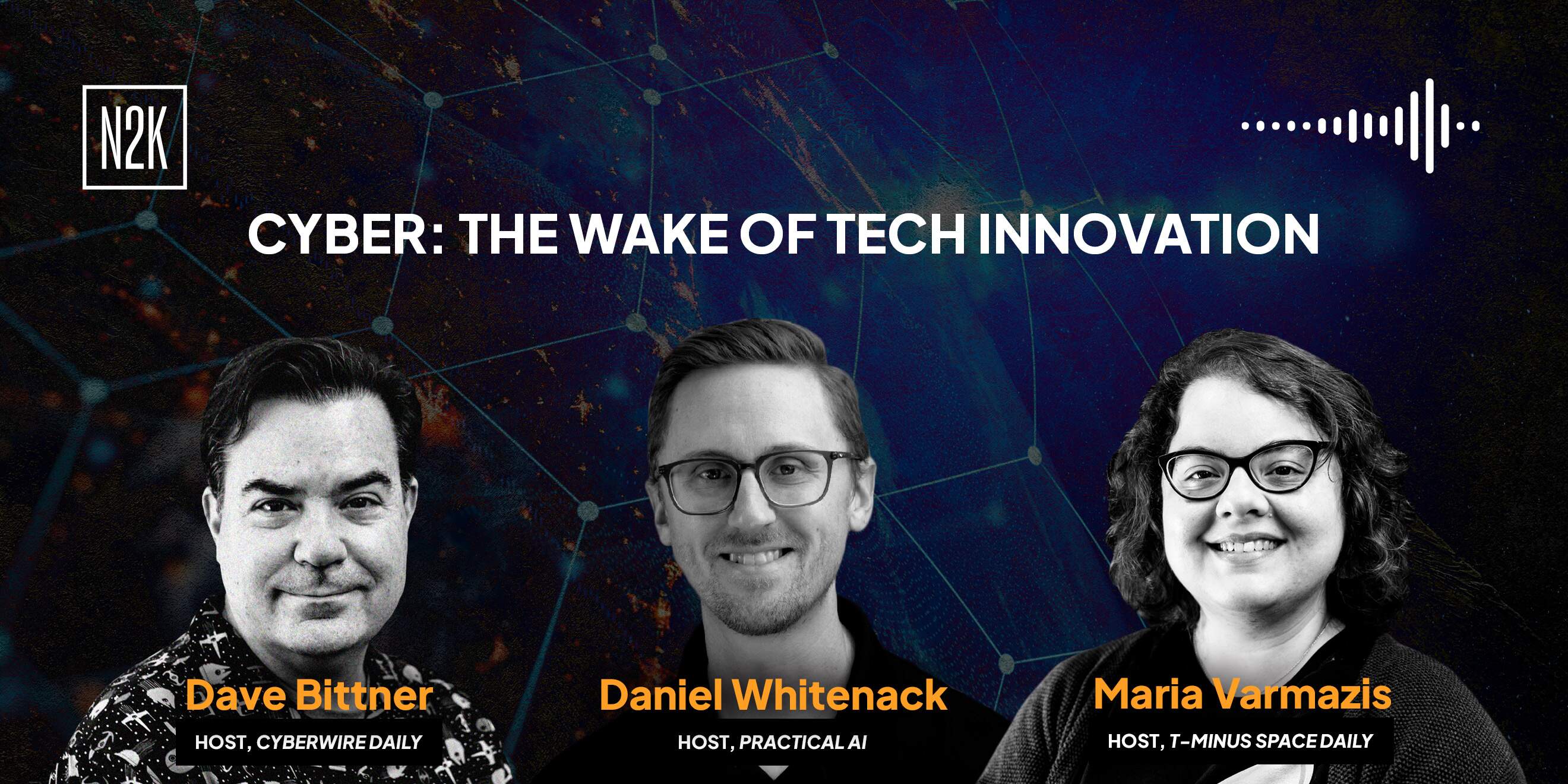


DataTribe's Cyber Innovation Day: Cyber: The Wake of Tech Innovation.





Dave Bittner: Today, we're bringing you a special conversation recorded live on stage at DataTribe's Cyber Innovation Day. The session is titled "Cyber, the Wake of Tech Innovation." I was joined by two of my fellow podcast hosts, Maria Varmazis? from the "T-Minus Space Daily" and Daniel Whitenack from "Practical AI" for a wide-ranging discussion in front of a live audience. Here's our conversation. [ Music ]
Leo Scott: Dave Bittner is the host of the "CyberWire Daily," in addition to many other podcasts. Maria Varmazis is the host to "T-Minus Space Daily," and Dan is the co-host of the "Practical AI" podcast, and also, the CEO of Prediction Guard. You can find him at his booth out back. These three podcasters can cover from cyber to, of course, AI, all the way to space. And so, it'll be very interesting to hear what they have to say about the intersection of frontier technology innovation and cyber innovation. Please welcome Dave Bittner, Maria Varmazis, and Daniel Whitenack. Come on out. [ Applause ] [ Music ]
Dave Bittner: All right. Well, thank you all for joining us here today. We're going to have a good conversation. I'm not so sure about what Leo said about us having some kind of a showdown or something like that.
Daniel Whitenack: I thought there would be an obstacle course.
Dave Bittner: Right, and I'm a little -- so maybe they'd issue us all lightsabers or something like that so we could go at it together, but happy to be here, and wow, what an exciting event in this new space this year. It's really great to see over the years how this event has grown. What I hope we're able to bring to you today is our perspectives from the unique point of view that we share as people in our unique position in the cybersecurity world, in the tech world. As podcasters, we talk to a lot of people about a lot of different things and often get perspectives that are different from those of you who are doing the day-to-day kind of stuff, so that's our value proposition for you all today. I'll start off just with some introductions. Leo mentioned I'm the host of the CyberWire Daily, which I like to say is the most popular cybersecurity podcast in the world. I also like to say that I'm six foot two and 175 pounds. So take it for what it's worth. Maria, welcome.
Maria Varmazis: Hi everybody. I'm Maria Varmazis. I am host of "T-Minus Space Daily." I'm also co-host of "Hacking Humans" with Dave. We are colleagues. I worked in the cybersecurity world in the private sector for about 15 years before moving into podcasting, so I'm kind of an interloper in the space world, and I come at the space sector often with a cybersecurity lens. So it's very fascinating watching things changing in space, knowing where cybersecurity has come from, so yeah. Go ahead.
Dave Bittner: Dan?
Daniel Whitenack: Dan? Yeah. Excited to be here. So Daniel Whitenack, I'm co-host of the "Practical AI" podcast. I co-host that with a guy named Chris Benson, who is a principal AI research engineer at Lockheed Martin, and we've been doing that now for eight years, which is definitely way before AI was invented. And yeah, I got into kind of the data science world back in kind of 2011, 2012. That was a different hype cycle, the kind of "Forbes Sexiest Job in the World" is the data scientist, so that seemed like a good idea to me. And I got into data science and kind of have been in data science, machine learning, AI ever since, and also founded Prediction Guard a few years ago now.
Dave Bittner: Well, let me start with you, Dan, and this notion of practical AI. I think it's, gosh, seven or eight years ago at the RSA conference, it was "The Year of AI." Everybody had AI. That was the hot topic, but it was a different AI than the hot AI we're in right now. Where do you suppose we stand in terms of the practicality of those different flavors of AI?
Daniel Whitenack: Yeah. I think just for people's context, like a lot of things with AI, the terminology has gotten very jumbled, and that makes it hard to kind of decipher these different categories. What I would say is we've had AI with us for a long time. Maybe that's more kind of machine learning, statistical models, things like computer vision or spam filters or that sort of thing. And there is still a huge amount of that that's applied across industry. These sort of task specific models, I would think of them as not general, but task specific models still widely used across industry, so very practical in that sense, but not, kind of, maybe, accessible for the, kind of, general public. And then, we shifted into kind of from 2017, if you remember, Google released some models, things like BERT and other things like that. There were computer vision models like YOLO and some others, and this kind of shifted us into a zone of what I call "foundation models." So this is where someone like at Google or something like that, that has access to a bajillion photos, trains a very large foundation model, and the goal is I then take that -- maybe it's a general purpose object detector model that detects airplanes and people and cars and things, and I want to now detect defects and parts coming off of my manufacturing line. So rather than me starting from scratch, I take Google's model that they've trained on a bajillion photos, and I just fine tune it a little bit to my use case. Again, this is still something that, sort of, is not accessible to a non-technical audience generally because it involves data curation, model training, lots of iteration, tuning hyperparameters, and these sorts of things. Then eventually, what kind of happened was as these foundation models got larger and larger and as they got trained on, kind of, more generic tasks, specifically text generation tasks, people found that they could use the models off the shelf. So now OpenAI, Anthropic, Google, whoever it is, Meta, trains these very large-scale models on kind of all of the Internet's worth of data. And now, I can use those models off of the shelf without fine tuning to do things like create automations or produce content or analyze certain tasks or generate code. And so, that's what has kind of led to this pervasive expansion because now that general purpose model, it's kind of squeezed out this middle between, like, engineering -- it used to be it was engineering, data science in the middle, and then over here was business domain experts. Now those business domain experts can kind of skip over the data scientists and just put their problem right into these models which are approachable and actually get value out very quickly.
Dave Bittner: So I'm fascinated by one of the things you said there about, sort of, squeezing out the middle and because you've been at this as long as you have. So you've seen the general AIs come online. I guess the way I want to phrase this is, is there a peril in making these tools available to just anyone that there is no longer the gatekeeping of being an engineer and all the things that may come with that to be able to put these tools to use?
Daniel Whitenack: Yes, I would say that there is, and especially, I would highlight that in recent times because people have gone -- people are familiar now that there are certain risks with individual interactions with these models, things like prompt injections, which is malicious input into the model or maybe toxicity coming out of these models. But actually, now what we're doing is we're connecting these models to a bunch of different systems under the hood that are not AI systems, but maybe they're other APIs; they're data sources; they're external and internal. And so, now, really, what you have is a very easy interface that could trigger a series of interactions with a wide number of systems under the hood, and if you kind of now imagine and, you know, maybe Maria would want to comment on this, but you have a natural language interface that could help you do any number of things with systems under the hood from booking a car on kayak.com to changing the configuration on your satellite to, you know, controlling things in the physical world, in a manufacturing space. And so, obviously, if there's, kind of, enhanced agency, then that produces a lot of, kind of, nightmare scenarios. So it's really this complicated system that's popped up that I think has increased the potential for disaster, if you will.
Dave Bittner: No, good times, good times. Maria, let's talk about space a bit. For folks who aren't familiar with your beat, can you describe for our audience what your day to day is like?
Maria Varmazis: Sure. So on "T-Minus," I cover the global space industry. So there is still a large perception in much of the world that the space domain is owned by governments and the military of various militaries. But just last year, the global space industry was a $614 billion industry with, I want to say, like 70% of contracts actually going to the commercial sector. So it is a massive, massive industry we're expecting to be worth over a trillion quite soon, and a lot of what I cover is talking to commercial companies where, granted, you scratch underneath the surface of a lot of contracts and there is a government often under there. But the space industry, which has historically been extremely hardware focused, hardware forward; that's where the cool tech, the coolness of space comes into play, where everyone goes, oh, space is so advanced. And that's, usually, yes, on the hardware side, it most certainly is. On the software side, they are very, very, very behind, and this becomes a really fascinatingly scary place when you start talking about the growing threat landscape and attack surface of space systems, which are becoming increasingly interconnected, increasingly consumer focused, and increasingly using commercial off the shelf parts, so I would say -- my pitch to a cybersecurity audience is having come from the cybersecurity industry, moving into space, I was shocked at how far behind on some cybersecurity basics the space industry is as a whole because there's still largely a perception that the military's got this. We're good. We don't need to worry about it. Also, why would anyone want to hack a space system, which is really sweet, but just not the reality of geopolitics nowadays. We've talked a lot about various nation-state rivalries that certainly also exist in the space domain. Space is increasingly becoming militarized. The rulebook for space, which was the 1967 U.N. Treaty for Peaceful Uses of Outer Space, something like that, dictated that all treaty signatories would use space for only peaceful purposes, and that has kind of gone out the window in the last few years. We saw in 2022 the opening salvo of Russia's invasion of Ukraine was actually a cyberattack on ViaSat commercial space systems. And that has sort of been like the big bad, see, bad stuff can happen in space, too, in the cyber realm, people. I'm not trying to do FUD on the space sector here, but there is -- I think of the space sector being about 10 to 15 years behind a lot of the conversations that we've been having in the cyber realm for quite some time, which I still find just, honestly, really surprising because going into the space sector, I said, they're super advanced. On the software side, though, they've got a long way to go.
Dave Bittner: Yeah, I mean, you talk about being behind, but also, combined with this, I guess, notion of safety or the elite nature of space that it won't be touched.
Maria Varmazis: Yeah.
Dave Bittner: I remember decades ago in a previous career, I was working in the television world, and I was having a conversation with a satellite engineer. He was the person who was responsible for getting the signal to the satellite and then back down again. And I asked him, I said, John, what -- you know, you've got this transmitter here and you aim your dish at a satellite, and you fire up your signal. What's to keep you from taking someone else off the air? And he looked at me kind of puzzled and he said, "David, we're gentlemen."
Maria Varmazis: Why would anyone want to do something bad to something space-related? It's so cool.
Dave Bittner: Right, and he was dead serious.
Maria Varmazis: Yeah.
Dave Bittner: I suppose now that notion is kind of adorable.
Maria Varmazis: Still prevailing, though, I would say.
Dave Bittner: Right. So we had this story recently that we both covered about -- I think it was Wired Magazine. There were some researchers at the University of Maryland and elsewhere who, basically, they just put out some antennas.
Maria Varmazis: Yeah, just one, I think, just one little antenna.
Dave Bittner: And started listening to the frequencies that satellites use, and they discovered?
Maria Varmazis: They discovered a whole bunch of very sensitive military criminal investigation and anything sensitive you can possibly imagine being sent in the clear. It should not have been. This should all have been encrypted, but it was being sent very much in the clear. So pretty much, as long as you had an antenna that was just listening, you could spy very easily on the operations of a whole bunch of military and police operations and very, very sensitive missions. I think they used an $800 antenna and they just kind of parked it on the roof of a nearby parking garage. There was really very little sophistication here, and it is sadly, honestly, that easy. Going back to the ViaSat attack in 2022, satellites, hacking satellites is really cool and sexy. I know at DEFCON we love to take a look at that, but it was the ground systems that were hacked in ViaSat's case, just unpatched systems in the ground systems. It was just a matter of basic security hygiene that wasn't followed. This is a very familiar story in the cyber security world. And yeah, that allowed the attackers to completely disable a whole swath of communication satellites over Eastern Europe, basically hiding Russia's opening salvos in their invasion of Ukraine. So that was just one example of how cyber and space often are intersecting nowadays, because they are both seen very much as a front line in conflict, increasingly in geopolitics. And, of course, they are increasingly intertwined.
Dave Bittner: Is it fair to think of space systems as ICS systems, as industrial control systems?
Maria Varmazis: Yeah, I that's often how I try to think of it, because satellites themselves are basically not as -- not solely anywhere -- largely, they are just transmitting data. They're not doing a whole lot of thinking on board, although that is changing. Edge computing in space is still talked about a lot. It is going to become a thing, but it's not really a huge thing yet. But yeah, it's -- a lot of the things that are going on in space are really -- a lot of the same problems you see with industrial control systems, but increasingly, more systems that are using space as a dependency are becoming cellular enabled and directed devices, huge satellites. IoT is becoming bigger and bigger, so a lot of the familiar problems that we've talked about with ICS cybersecurity for decades are absolutely going to be applying to space systems, as well, because more and more organizations, more and more commercial entities, more and more governments are becoming dependent on satellite connectivity for all these different applications. [ Music ] We'll be right back. [ Music ]
Dave Bittner: So we've got a lot of people who are interested in investment here in our audience today. It's a big part of what the DataTribe Challenge is about, of course. And I'm curious, the two of you, to what degree do you believe with AI are we in a bubble? Now, I'm thinking of two different bubbles. There's the financial bubble, the investment bubble. You know, there's the joke about the only company making money off of AI right now is NVIDIA, right, because people are buying cards. But there's no question that it is the hot space to be in to put your money, so there's that bubble. But then, there's also, I think, the general sort of public fascination with it. Are people going to get over that? We're enamored with it right now. Dan, let me start with you.
Daniel Whitenack: Yeah, well, first off, I have to say, sometime this week, our podcast episode will go out, which is on this topic, "Is AI a Bubble?" so thanks for the question, because I'm glad I prepped. Yeah, I would say there's -- I mean, first off, in reference to the NVIDIA thing, certainly they're making a lot. I think the ones that are making a killing in the AI space are the services companies, so the KPMG, Deloitte, Accenture, et cetera, because you sort of have all these general-purpose AI systems, but everybody knows it's kind of like when you buy a CRM. It's a general-purpose CRM. You need some consultant or, like, a NetSuite or something like that. Often you need actually a services layer on top of that because it's too generic for your company. You've actually got to build in your domain knowledge. You've got to connect your data. You've got to do the integrations. You've got to do all the security work. And so, there's a big business right now on that side of things, but you've seen a couple of things, the NVIDIA, I think now $5 trillion valuation. You saw what was kind of coming out from Powell. I believe it was last week when he said, we're not in an AI bubble because, I won't name the names, but they have revenue or something like that was his statement, which I think we could infer certain things. But yeah, I think there is the reality that AI companies are actually bringing in revenue, which is kind of an argument for the we're not in a bubble side of things. I do think that there's still speculation because I very much hope that, kind of, a generic chat application and chatbots proliferating everywhere like the chat interface is not the killer AI app. The sort of killer AI things are those verticalized domain specific AI plays that, like I say, figure out how to take that general-purpose model or those general-purpose AI systems and infuse them with domain knowledge and data integrations that are specific to a particular vertical. So I think those are particularly strong in terms of their potential for revenue. I think we've already seen this over the last couple of years, but you've seen many companies that were maybe had speculative investment that were just kind of maybe thinner layers, thinner generic layers, on top of an already generic AI system, and those have kind of been consumed by the underlying AI system. So things like code execution, web search integrated with the AI model, tool calling, those sorts of things are now kind of part of the platform and are part of AI platforms that you just kind of expect to be there. And so, I think those are, from my perspective, the more-riskier side of things because those are being consumed by that underlying platform side. On the cyber side of things, since that is the topic of this conference, I think you've got a series of plays that are AI for cyber. This would be, you know, application of AI agents to help the, you know, SOC or whatever, and then you've got security for AI. With me coming from the AI perspective, I'm coming much more from the kind of security for AI side of things, but there's certainly a lot of interesting things happening on the AI for cyber side, but I do think there's a lot of interesting open problems on the security for AI side because these systems are getting more complicated. Like I said, it's not just a model where you put a guardrail on top of a model and that solves your security problem because you've got supply chain vulnerabilities that have to be taken into account, in terms of the model assets that you're bringing into your organization. You've got hosting and code execution problems, which have to do with both the code being generated from the models, but also the code running the models and where that's communicating and the dependencies there, the networking around those environments where you're hosting the models, and then, you've got the online side, which of course involves all of these things like insecure tool calling, prompt injection, sensitive data disclosure, toxicity, et cetera, which have to be monitored at the, kind of, application level and have to be integrated back into centralized alerting and monitoring. So there's no shortage of problems there that people will necessarily have to deal with on that side of things.
Dave Bittner: Maria?
Maria Varmazis: Okay. To address the, is AI a bubble in the space -- I guess in this case, it would be a vertical kind of to piggyback on what you've been saying. Certainly, when I'm feeling very cynical, there are many players in the space domain that are just slapping AI on a product and going, here, we're fixing a thing, but there are several areas in which I'm actually very excited to see AI playing a huge role in advancing space capabilities. Firstly, on the cyber side, actually getting to what you were saying, given my thesis, which people are free to disagree with, that I think the space industry has a long way to go on the cyber side, I think AI can prove to be huge in helping them catch up at speed, because certainly, with geopolitical tensions being what they are, that is a really growing, pressing need. On the application side, just thinking strictly within space as a vertical, this is something where AI has just been absolutely transformative, because again, with a lot of space systems being very hardware focused, they're really good at hoovering up terabytes of data to, you know, thinking of things like Earth observation, where you have a satellite taking petabytes, terabytes worth of data every day in high resolution. And historically, a lot of that data just sat on a server with nobody to look at it, unless someone thought about it and then had the ability to go and pore through all of it. And now, with AI, insights can be gleaned very quickly from this massive amount of data, and there are a number of space companies that are also putting AI -- or hoping to put AI -- on the satellite itself. So the data doesn't have to be beamed down and then analyzed, it is being analyzed in real time on the satellite, with the insights being beamed down very quickly. So speed and revisit times have been historically a really big problem with satellite imagery and data being useful, especially in combat situations or other situations where, like, illegal phishing is something that's being monitored, but there are a lot of industries that are popping up within the space vertical that are now able to take advantage of the high rate at which AI can pour through this data. So, like, insurance is a big sector that's really benefiting from this. Climate change and disaster relief is another one. A lot of local governments are now able to study the landscapes of places within their countries to see how things have changed after a flood, and then predict, thanks to AI, what kind of mitigations they need to take, which I actually interviewed the World Bank about this about a year ago. This is something that would have taken some countries like decades to do, and now they can do it in months. I mean, the speed at which the improvement can happen is just massive, so while I can be very cynical about AI personally in the space domain, I have just been blown away to see how people are using it. There is a whole cottage industry blowing up within the space domain of people just trying to figure out, now that we can do all this stuff with the satellite data, what can we make with that? And people are really trying to figure that out, that kind of killer app idea, so it's coming.
Dave Bittner: Yeah, I also wonder, like, what would it look like if the bubble burst? Obviously, lots of people would lose lots of money. That's a bad thing, but at the same time, the internet didn't stop working after the dot com bust, right? In some ways, it enabled, it cleared things out and enabled new things to happen. One thing I think is interesting from our point of view as podcasters, I know certainly for me, we have the perspective of getting pitched by everybody. Everybody wants to promote the thing that they're doing, their company, their service, their product, so we get to see and survey a lot of the things that are going on. Where I'm going with this is, there was a story today, actually in today's CyberWire. MIT had teamed up with a private company, I think it was Safe Security is the name of the company, and they put out a report, a white paper report, whatever you want to call it, about AI and the proliferation of AI among ransomware groups. And it was factually problematic, let's say, and some high profile researchers looked at this and said, this is not based in reality. This is wrong. These numbers -- there was a number like 80% of all ransomware attacks make use of AI, and they were naming ransomware groups that don't exist anymore or stopped existing before we had the current AI boom, so there's all sorts of problems with this report, and they pulled the report. What's interesting to me is the combination of an organization like MIT, with a stellar reputation, partners with a private company, they team up to do some research together, certainly funding has changed hands to make this happen. And then something gets published that's full of errors, factually wrong in a lot of ways, and we have to weed through that, right? We have to decide, is that newsworthy? In this case, the story is the retraction. So there's a -- you know, the Streisand effect is kind of working against them on this one. The story is the retraction, so it's going to get way more attention than it otherwise would have. But I'm curious, you know, particularly for you, Maria. I don't know what your process is, Dan, for guests and things like that, but sorting through the noise, the marketing noise that is so pervasive, particularly, again, with AI stuff, to try to curate, to figure out what is it we're going to share with our audiences that we've earned, who've come to trust us. What does that process look like these days in this? Is it fair to say, let me start with you, Maria, that is a high-noise environment?
Maria Varmazis: Yeah, it certainly is. It's gotten a lot noisier. Yeah, and I sympathize a lot with companies because, again, I worked in the private sector. I was on communications teams, and I know that especially if you're in the B2B realm, it is really hard to figure out a compelling narrative every time you have like a GA. It's just really, really hard. So, you know, companies are trying to figure out how to make their stories sing so they can get that media coverage, and it's a hard problem. The issue that I'm seeing is I'm getting a lot of pitches where the story is really garbled and lost in there. They've really leaned heavily on AI to write them something, which is fine, but it really needed an edit. And the volume I'm getting now is sometimes getting a little overwhelming. And it is getting more challenging to cut through that noise because I know that listeners to "T-Minus" trust that humans are actually curating the work that we're doing. We're reading it. We are writing it, like, that's -- the human touch is extremely important in what we do, and AI is huge in space. So we're reporting on space a lot; I've interviewed a ton of companies who are using AI in space to practically miraculous effect. But the human touch is so important, and it just feels like it's getting exponentially harder to keep up with.
Dave Bittner: Dan, what are your thoughts?
Daniel Whitenack: Well, I guess our hot take on this is we just ignore everything because we've always -- so Chris and I just sort of think about what we want to talk about, and then we find folks. Occasionally, there will be an outreach from, you know, someone that that is legitimate. And, you know, I think Waymo outreached, and we worked through their press team and found someone we'd want to talk to. So there occasionally is something like that, but our advertising, we do have some ads, but that is completely -- so actually, I don't have anything to do with any of that. All of that comes to a separate team, and I don't even know what the ads are that are going to be run, and there's no connection between that and the content. So a lot of it is just maybe it's a selfish thing because it's my weekly excuse to spend an afternoon talking about something that I want to learn about or something that, you know, we found interesting. And so, a lot of what we do is outreach now on that side. And maybe we're missing things because of that, but it's fun that way.
Maria Varmazis: Fun matters in this stuff. It matters a lot. So, yeah.
Dave Bittner: we're going to get to questions here in just a second, but sort of piggybacking onto that, I think, and also, I guess, in some ways related to that MIT story. Look, there is I'm not against sponsored content. We have sponsored content. It is part of how we keep the doors open, right? You've got to -- you have to pay people. It takes teams to do the things we do, and you have to make money to keep the doors open, and sponsored content is one of the ways we do that. But we are overt, perhaps overly overt, when we have sponsored content that -- to say this is sponsored content so that people there's no ambiguity there, and what I'm seeing, what I'm sensing is that there's more and more of a gray zone when it comes to sponsored content of not being overtly called out. And that, and I -- my personal feeling is there's something kind of icky about that, and maybe I'm naive and innocent and cute, but I wish we had higher standards when it comes to that.
Daniel Whitenack: Yeah, I think it also it puts some pressure on kind of all of us in the room when there's such a proliferation now of generated content as well. You know, I am not saying the MIT report generated their report with AI, but, you know, everything is just kind of AI slop now, and it's hard for us to kind of work our way around that. I think that's true whether you're us on the stage or whether you're just doing, you know, your work as a VC or a startup or whatever it is.
Maria Varmazis: Yeah, because then reputational damage can go two ways on that. So if we get a press release that was poorly written, and there's factual errors in the press release, I am not a fact checker. I'm not a literal rocket scientist, so I have to be able to trust what I am reading is correct. So if we publish something like this MIT report, which we didn't, but I'm just saying, for example, that ends up that was incorrect, then we also lose our reputation. So that's part of the calculus that we're always doing in our mind is I really hope I can trust this press release or this this PR contact or this person that I'm interviewing that what they're saying is actually true.
Dave Bittner: Yeah. And we run corrections because sometimes errors are made. All right. Anybody out here have any questions? It is hard for me to see. Raise your hand. Yes, sir. Come on up and come to the mic and introduce yourself and let us know what you'd like us to answer.
Evan: Yeah, absolutely. My name is Evan. My question, I guess, is for all of you. So the phrase "earned audience" was just said, right? It's no secret that podcasting is a very crowded space, especially when people have access to the same news wires and things like that. How do you as the host capture those ears for the first time and ensure that they continuously come back to you, and you alone, when they could go to anyone else that's covering the same topic?
Maria Varmazis: That's such a great question. Dave, I feel like you're the OG. You should really answer that.
Dave Bittner: Well, so look, we've been doing the CyberWire for -- at the end of this year will be 10 years. So there is definitely a component of being one of the first to market with a quality product that uses high standards for audio quality, for editorial quality, all those kinds of things. So it was much easier for us to set ourselves apart at the beginning 10 years ago than it would be today. I believe that is why we have not seen many people come and try to compete with us, right? A daily news production is a lot of work. I like to joke that we make it look easy, but it's not right? It can be a grind. The other thing I'll say, I'm a big fan of Steve Martin's autobiography. It's called Born Standing Up, and I highly recommend you read it. A friend of mine who happens to be in the audience was saying that he has all of his salespeople read it because the like of a stand-up comedian is being told no. It's getting up in front of a group of strangers and having them not laugh at you before you learn how to laugh. It's persistence and learning how to do your pitch. Steve Martin in his autobiography says, "Be so good they can't ignore you," and I think that's a big part of it too. You're not going to be great right out of the gate, but keep at it. I like to think that I'm much better at my job than I was 10 years ago when I first started. I know I am. And so, you provide value for your audience. You respect them; you don't waste their time, and provide something that's entertaining and valuable, and hopefully, they'll stick around. I know the three of us have all been lucky that for whatever reason, what we've been doing has resonated with enough of an audience for us to be able to keep doing what we do. All right. Does that answer your question? All right. Next up. Yes, sir.
Unidentified Person: Yes, Dave, Maria, thank you for your time. I was curious, Maria, from a software innovation side of things in space, what do you think that may cause the lack of innovation on the software level, given the fact that we now have accessible hardware with Jetson Nano and Raspberry Pi, and Python models that can be run using ONNX runtime deployment, as well as accessible data, things like GNSS lattice that's available with electromagnetic signals and things like that. So why aren't people building these solutions with the data that's available and the hardware that's available when you really just need a computer with VS code and Python installed?
Maria Varmazis: Well, that's a great question. So some of it is just making money, it's a matter of what are we building these systems for? And again, space is a business largely, but yeah, there are a lot of Pico satellites and CubeSats that are using literally just a Raspberry Pi in space, but is that enough for a business to achieve what they want to do? It might be for maybe a small mission, but they might not be able to do what they need to do at scale. Hardening systems for space is, indeed, a challenge. It is something that is very expensive to do, but we are, actually, to your point, we're at a really interesting intersection right now in the space industry. And it's one of the reasons I love covering it right now is because it is getting cheaper and cheaper to send things into space. We are seeing more companies willing to experiment with setups exactly like what you describe, trying to say, like, we're going to make the leanest machine we can possibly make with literally as much commercial parts as we can. Can we achieve what we're trying to do and deliver value to our customers with this? Increasingly, we are seeing the answer is yes. So I think some of it is legacy mindset, where not that long ago, I'm going to say that 20 years ago, we were able to measure satellites in the hundreds, like maybe 800 hundred. Now we're well over 10,000. We're looking at probably 100,000 a lot sooner than all of us might think. So things are accelerating exponentially, probably maybe not logarithmic anywhere exponentially. But yeah, we are moving in that direction. So some of it is people who want to work in space, literal rocket scientists, want to make the coolest hardware that they can. But now that we have a lot more business folks moving into the space industry and/or businesses that are realizing that space is a vertical that they need to have some integration with, we are seeing more of exactly what you're describing, so I think it's a stay tuned. Missions in space do take years. Cycles take a long time. Whatever you might say, it takes a lot longer than you might think to get stuff into space, but these timelines are shrinking. Just in the last year, we had a mission to space that the Space Force did that took like a 24-hour turnaround, which is insane. So it's just -- things are going so fast. So yes, we will be seeing more exactly what you're talking about.
Audience Member: All right. Thank you.
Maria Varmazis: Yeah.
Dave Bittner: When I was in college, my one of my roommates was an electrical engineer, and he was also a ham radio operator, and he and a bunch of his ham radio buddies actually got a little, like, one foot cube thing that went up on the space shuttle, and that was how you had to do it. But to your point about it being cheaper and cheaper to get it into space, I guess that lack of financial gatekeeping leads to opportunities for innovation.
Maria Varmazis: Yeah. And that's part of the reason why a lot of us space nerds are very excited about what SpaceX Starship will provide. That'll make it even cheaper to get even bigger things into space, and that will unlock a whole -- there are so many businesses that are literally waiting for Starship to be viable because it's just going to allow more opportunity than the SpaceX Falcon 9 did. So it is just -- the fact that it's getting cheaper and cheaper to get into space, there are more companies that can work in space now. It is -- it's pretty much green field. I really believe that, so if someone can figure out how to make their business work with the space aspect, there's lots of play there.
Dave Bittner: All right. We've just got a couple of minutes left here, so we're going to rack things up. I'm going to ask each of you. Let me start, Dan, with you. What's your level of optimism when it comes to cybersecurity, AI? As you look towards the horizon, where we've been and where we're going, what's your temperature these days?
Daniel Whitenack: Yeah, I -- I'm fairly optimistic. I think part of that is driven just by doing iterations of my conversations with people on the podcast, but also, discovery calls through the business. I have seen a shift in the past five to six months, a real shift of sophistication of people that are in in enterprise settings around, number one, the optionality they have in terms of, kind of, model and platform, et cetera, but also an understanding of maybe what they need to do from a security standpoint around AI. They might not know exactly how to enable that, but there's certainly more sophistication, less education there. There's still very hard problems to solve, but my optimism is high.
Dave Bittner: Maria?
Maria Varmazis: I am more optimistic now than I was a year ago, but sort of beating the drum that I did at the beginning of this talk, the need is so great in this cyber realm in space. I see more organizations taking it more seriously. Certainly, shifting geopolitics, again, has really raised the temperature on this, so I'm more hopeful now, but I would like to see things moving more.
Daniel Whitenack: Dave, are you --
Dave Bittner: Oh, I was afraid you were going to ask me. I am, by nature, an optimistic person, so I would say I am, overall, optimistic about where we're headed. I think the acceleration, the rate of change that got goosed by AI, it seems like that's going to continue for a while, and I think -- I tend to not bet against people. I think we are clever, and we tend to be able to think and get our way out of the problems that we create for ourselves. It can be messy, but I think the long arm of history shows that things do tend to get better, so I'm going to go with that.
Maria Varmazis: That's nice.
Dave Bittner: All right. Thank you all for listening to us. I'm Dave Bittner, Maria Varmazis, and Daniel Whitenack. Thanks so much for joining us. [ Music ] That was our live panel from DataTribe's Cyber Innovation Day. My thanks to Maria Varmazis and Daniel Whitenack for sharing the stage with me, and to everyone in the room who joined us for the discussion. We're pleased to bring it to our CyberWire Daily audience, and we hope you enjoyed it. I'm Dave Bittner. Thanks for listening. [ Music ]