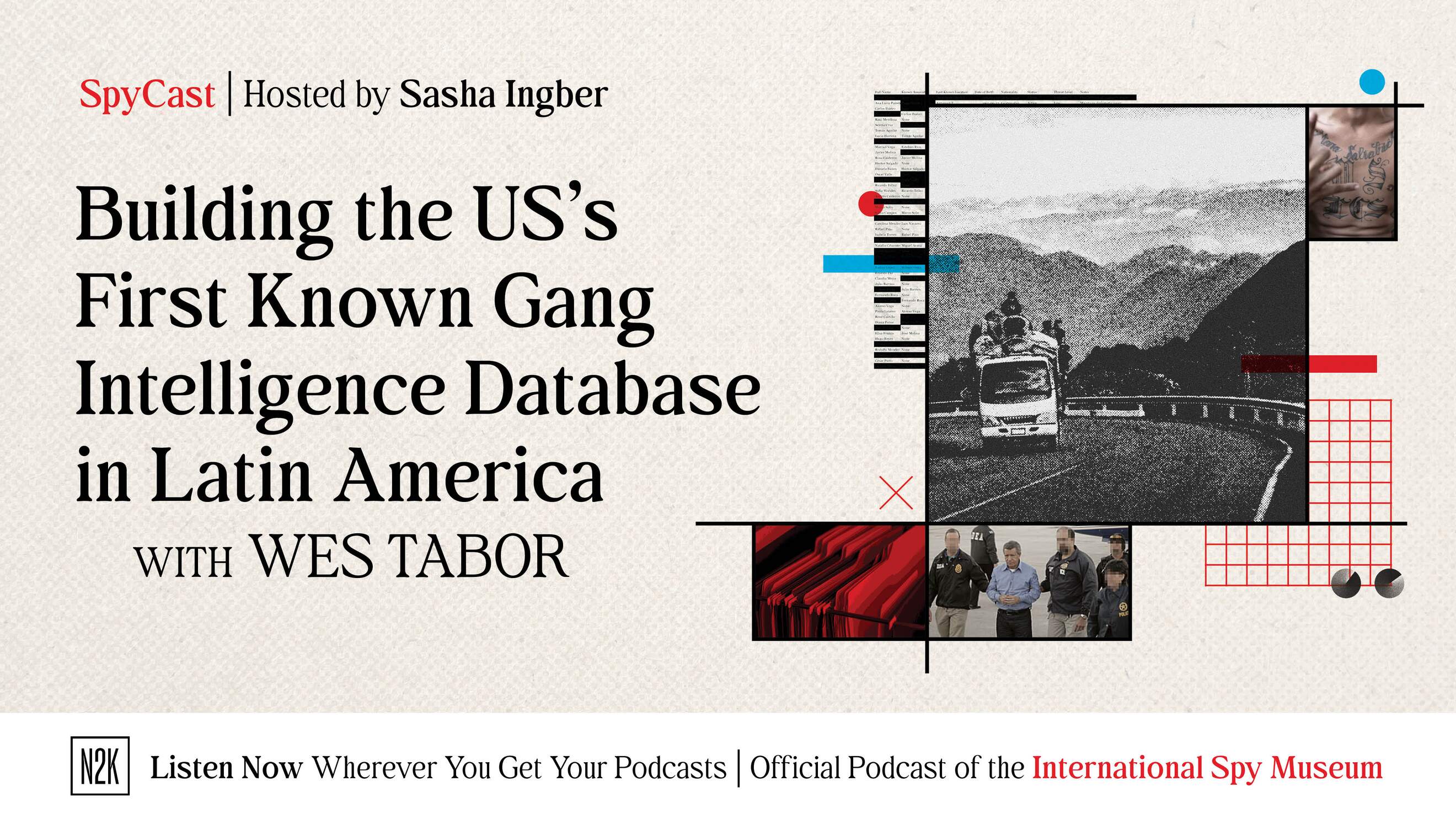


Building the US’s First Known Gang Intelligence Database in Latin America










Sasha Ingber: Welcome to Spycast, the official podcast of the International Spy Museum. I'm your host, Sasha Ingber, and we're in the midst of a month of episodes on Latin America. Crossing borders and decades to explore clandestine activities that have shaped our world as an agent with the Drug Enforcement Administration, who later embedded with the CIA, Wes Tabor worked to dismantle criminal networks in Central and South America. Think gangs like MS 13, the Sinaloa Cartel and Tren de Aragua. And in 2006, he was stationed in Guatemala, a transit corridor for South America's cocaine to enter the US. It was during this time that he created a gang intelligence system using bio data and records from regional prisons and police departments to help identify gang members. Two retired DEA agents told me that the FBI took the database and made it their own. This is how it happened.
Welcome to Spycast Wes.
Wes Tabor: Thanks for having me.
Sasha Ingber: So why did you start this database? Because it's my understanding that nobody at the DEA asked you to do this.
Wes: No, they didn't. You know, I was stationed in Guatemala City at the Guatemala country office, junior guy.
I was like 34 years old, and I remember I was in Guatemala on the couch watching American television and they were talking about these gangs and they were talking about how this one suspect had fled back to Central America from Los Angeles. They're trying to figure out who he was and they were trying to track him down and I said, well. Geez, here I am in Central America. I go to El Salvador all the time, which is like the Mecca for MS 13, but they're also all throughout Honduras or Guatemala and so forth. So I said, I wonder if I could create something where we could track these guys.
Sasha Ingber: Okay, but why wasn't there already something like this? We're talking 2006. It's not like this is the dawn of the internet.
Wes Tabor: Well, for DEA and federal law enforcement, it was more seen as a local problem for the most part, from how my viewpoint was. And even though they were spread out a lot in the prisons, they were spread out through California and some other states, Arizona and Texas.
It wasn't seen as a. National problem for national law enforcement elements like the FBI, HSI or DEA, right? So for me, I was like, well, these guys. They traffic drugs, smaller quantities than the normal traffickers we're dealing with, but they still traffic drugs, they traffic people, they traffic weapons, they use funny money counterfeit funds as well.
So they do all these different crimes as well as homicide. Why wouldn't we put that in our wheelhouse and have a tool to combat them and kind of figure out, okay, where are they? What are they doing? How can we track 'em and get a metric? For what they're doing around the nation. That's what I was thinking actually. Just sitting on the couch watching that. Yeah.
Sasha Ingber: It's also sort of strange that it was not seen as a national problem when when, when you had the CIA involved in operations to do with drug trafficking overseas, why the DEA would take that track?
Wes Tabor: Well, I think you had a lack of. What was going on in the country and what the relevance was to these gangs because they looked at 'em like they were small potatoes. Something for the locals to kind of deal with. And when you look at what the claims were against CIA in Central America, and you know, what they were doing with all the different transportation claims that they were moving weapons and Nicaragua and all this stuff, and Panama and so forth, all these wild claims that were out there, that became these wild legends, right?
You really didn't have too much involving with the MS 13 per se. It was more traffickers, but you have the relationships with MS 13 in Latin America and the traffickers because the MS 13, for example, is working on the borders. They're doing the lookouts. They're helping with the local traffic and the transit zones and so forth.
So I thought it was relevant and why no one thought of it before I, I could not tell you.
Sasha Ingber: You had also survived a really bad car accident, and I'm wondering if that plays into this.
Wes Tabor: I was involved in a, a horrible drunk driving accident. Someone hit me when they were drunk driving. Uh, this was in 2001, a couple years before I went to Central America.
The individual was an American, and then there's another individual from Africa on a visa and they had been out partying, very hard drinking. Dozens of drinks and got in the car and drove and hit me, broke my neck, paralyzed me from the neck down. I wasn't supposed to walk again. I was, I have a very severe spinal cord injury.
Luckily, I recovered and my whole goal was to get back to work.
Sasha Ingber: Nice.
Wes Tabor: The other individual had over 300 aliases. 300 aliases. He absconded when he bonded out 'cause he used a fake name and they didn't run his prints. So they botched the investigation as well and he fled and they didn't capture him until just a couple years ago after I retired.
That's when I found out that he had all these aliases and all these things. But going back to, to this database program, did it have an effect on, you know, how can I track someone? How can I do this? That was more, uh, based upon what I had. Experienced in my career in law enforcement, it, it was augmented in a sense from this guy that absconded, where is he?
We don't know all this, you know, my injury and so forth. But at the time it was more primal. I had to kinda like get back up on my feet. It wasn't until later I started thinking about that. But yeah, it was more of the criminal investigator in me. How can we track these criminals?
Sasha Ingber: What kind of data were you looking to put into your database?
Wes Tabor: As I'm, I'm sitting there thinking like, how am I gonna create a package that we can use to actually find someone? What do we need? Right? We have to have the fingerprints. We have to have usually a facial identification, photograph, photograph, it's sometimes straight on right. Tattoos, uh, anything we could use to identify someone so.
I wanted to go and first poll these agencies that work within these countries starting in Guatemala, right? So let me see what I can get and if they're gonna be open to giving it to me. Because remember, I'm a foreigner. I'm a foreign law enforcement agency. So here I am going to them saying, what can you give me?
And they said, oh, we can give you, here's a packet that we have in the prison. We can give you this, so it, it was like an arrest packet the prison has on you, and it shows their phone numbers, their family's information. It shows their gang affiliation. It has the photographs of all their tattoos, their fingerprints, blood type, medical information, all these things, phone numbers, people who visit them, a plethora of information.
That's very valuable if you're tracking someone, and that was just a prison system. Then I go to the prosecutor's office. They gave me all the crimes that they had been involved in. So now I have a criminal history on them. So now we're starting to put together multiple packets from different agencies.
And then when I started getting it, I said, well, what else can we do? What you know, where else can we go? We have the prosecutors, we have the jail, local police, the national police. We started spreading out as much as I could that would be manageable 'cause the only person doing this was me and it was collateral for me.
This was like a little project that my boss let me do. My local boss in in country, let me do it. So that's where we started. And the information would ultimately go to EPIC. The El Paso Intelligence Center, that's the DEA since the 1970s.
Sasha Ingber: Tell us more about the center and how all of this would work.
Wes Tabor: Sure.
So DEA wanted to have their own intelligence center that they could collate information from around the world. And then utilize it in a format to hand to local agencies as well as federal agencies and DEA itself, right? So we want to feed the information in, we wanna collate it, we wanna organize it, make it palpable, and then we wanna send it out to everyone.
One example, this would be a pipeline, for example, a program that you might have, you can read about it. Where you have traffic that's moving across the United States with traffickers moving drugs or money. The police officer in a local Wichita office, he might be a state trooper or a local police officer.
He stops the car on the highway and he finds 50 kilos of cocaine. They call the DEA office, DEA office shows up and says, Hey. We're gonna put this into our database. We're gonna get all the details that you got from your traffic, stop the phones, any intelligence that's within the car, the pocket trash, who these people are, everything that we can possibly do, put it into this pipeline program.
Then we're gonna send it out in bulletins to everyone across the United States, so everyone is aware of methods that people are using to transport narcotics across the roadways. And we'll do this with aircraft and airports, sea ports, all kinds of different novel ideas that we come up with. To fight crime and to disperse all of the different things that we have in the system so that locals can use it and it effectively use it.
Sasha Ingber: And could it also be used to identify, say the person driving the vehicle in Wichita?
Wes Tabor: Yeah, they developed the programs at first, very simple programs with the information built into what's going on, and later on they started developing programs that are gonna be proactive programs, license plate readers, facial recognition, all these different things.
So it's evolved over the years, but going back into like 2005, 2006 when I started this gang program. They didn't have anything like this whatsoever, and that's why the regional director said, this is a great program. We could do this, and we can make it interactive and we can make it proactive where we have fingerprints, we can start putting things in different computer systems, alerts and so forth. So make it more interactive.
Sasha Ingber: So what was the first place that you went, and can you remember what that conversation was like?
Wes Tabor: Well, I remember one of the first that I went to, I don't remember the specific one I got in my car. I drove to a municipality of a local police agency that was located just barely outside of Guatemala City.
And when I got there, I had already utilized one of my law enforcement contacts to meet with the local Fisca, which the local prosecutor and as we're going into his office, which was, it was like a two story, almost like an old motel looking building. Very decrepit. Okay. Very rundown. But that's the office they had 'cause they just didn't have the funding.
And as we're going in, there was shots fired over at a park across the street. And he brought me and he goes, ah, we have the shots all the time. Don't worry. The law enforcement's gonna be there, gonna take care of business. I said, okay, whatever. And he starts showing me all the files of homicides that were involving different gang members in his community.
And he would open the file and he'd show me all these dead guys and their tattoos. And he said, this is what I wanted to show you. So we have all these victim sets. You can look at, and then who are these? Who are these victims? Who are their associates? What are they doing? What's their gang affiliation?
Where is their family? What prison have they been to? Do we have anyone else suspected of killing them? Do we have leads on that? Where are those packets? Well, here they are. So we have kind of like the whole crime where we think, and some of these guys will fly or drive or flee to the United States of America and then we can actually help them find a homicide subject, right?
So I thought, wow, this would be a really good exchange program that we have exchange of Intel as well. It's not just one way to us, it's both ways. And that's where I realized why they were gonna be so cooperative with me.
Sasha Ingber: We're talking about 2005 when Guatemala's anti-drug chief had just been arrested on drug charges himself. Was there hesitation in any of this to share information with you?
Wes Tabor: No, because when you're dealing with local level police officers or or mid regional level police officers, they're looking at going after all these gang bangers. And let me tell you something, back in this day, they were brutal. They were brutal.
They were robbing and killing people at ATMs. I had a situation where I went to a nice area and I was going to an ATM, and I heard them on the next telephones, which are almost like walkie talkies back in the flip phone days. And I saw them zoning in on me at an ATM machine that I thought was safe. And I realized this is not safe.
But they did this all over the city, but they were robbing people in buses, bus stops, killing women and children. So even the corrupt police chief. His top brass, they despise these gang members too. So this, that was almost like, well, we have limits, right? We'll support the drug traffickers, right? Or, we'll, we'll deal drugs and we'll make money, but we'll never associate ourselves with these Mara Salvatrucha guys 'cause they were just savages, right?
So we never had a problem whatsoever.
Sasha Ingber: Huh, interesting. The layers of corruption and the standards of what one can accept. Um, what [00:14:00] other potential risks did you face as an American walking around doing this as a side hustle?
Wes Tabor: So one example of like the treachery that exists when you're just cruising around Guatemala is when I'm going into some of these areas, they're very, very dangerous areas.
Obviously they're gang infested, right? So I'm driving out and they had a history of getting on buses. Kind of hiding in the buses sometimes. Then getting up and then robbing the people on the bus when these are all all gang members. Right. And it was a rancid environment for them. So they would put undercover police officers on the bus sometimes, or they'd have undercover police officers get on the bus at a bus stop and then look for these gang members, potentially the ones that didn't maybe have things on their face, or they did and they were hiding whatever.
So I'm in my car, didn't have an armored car, but I had a gun. And all of a sudden we stop and we're in a lot of traffic and this gang member. Stumbles out of the bus getting shot, and I'm hearing the shots, and then I see him stumble out backwards and he has a gun in his hand. And I see these two guys, they look like police officers, but they're undercover police officers, but not really good undercover police officers.
As the gang member falls out of the bus, he drops his gun and he rips his white t-shirt off, which has blood holes, right? Holes and blood and everything else. So I'm watching this guy and I duck under my dashboard 'cause I'm expecting a gunfight. Is he gonna run by me? Is he gonna try and carjack me?
What's he gonna do? Right? We don't know what he's gonna do. So this guy rips his shirt off. Then I think he's trying to look at his bullet holes, right? Am I gonna survive? I don't know what he's thinking. The gang member stumbles into a ditch and the police officers are kind of like, come outta the bus for a second and then jump on the bus.
The bus leaves and a patrol comes and goes with them. So why did they leave the guy in the ditch? I think they were just kind of escorting the bus with the people who had been to this dramatic event. Maybe someone could have got shot in the bus, I don't know. But they wanted to maybe escort 'em out and they came back later.
'cause they didn't have, you know, enough police officers to converge on the whole thing. It wasn't like a big operation. They kind of do things ad hoc down there. You just never know. You go into these areas. The first time or one of the first times I had gone a police station. There's a shooting in a park right across the street.
I'm going to another place and now we have a shooting on a bus. So it was, it was a pretty treacherous environment if you get caught in the wrong place.
Sasha Ingber: Quite the commute. Quite the commute. When we come back, we look at the inherent vulnerabilities of an intelligence database.
We are talking about 10 years after the country's 30 year civil war. It's my understanding the prisons were overcrowded, were inmates sometimes in control? And when you walked into these prisons trying to get data, was that also a thought that you had to have?
Wes Tabor: Yeah, so one time I went into a prison. And we talked with one of the assistant wardens, 'cause we're going to a section that's kind of removed from the actual prison itself.
It's kind of on the side. So there was a separation element that was in our favor. So we felt pretty comfortable of it. But I wanted to go in and I actually wanted to talk to some criminals. Okay. That had been caught with narcotics. So I go in and he tells me about all these Chinese trafficked individuals that they got off a boat that had narcotics in it.
So when I go into this little jail area with about 30 to 40 guys in it, they are all sandwiched in this place. And picture an old jailhouse. With the flat bars from the, from the old West Days with the big lock on the door and the flat bars, the black kind of rusted, kind of like fragmenting bars. And as I came around the corner, of course, you know I'm six foot five white guy, right?
All these Chinese guys are in this cell and I have what we call a gafete. It's like an an ID and it says United States Embassy with a United States flag on it. When I came around that corner, these guys. All rushed to the bars, sticking their arms through the bars, reaching out, saying, America, America, America.
I mean, that left a real impression on me. I mean, these guys were so desperate. They were trying to get to America. It's, it's America. And when they saw me, their reaction was just so visceral trying to claw at me to get ahold of me to help them. Of course I could do nothing. They were in, they were in jail, and that was it brought that human element to these criminals or these trafficked individuals in this case, but the criminals were the same way too. So you know, that human element. I had not really had that too often in my career. I had realized that a lot of these people are, are suffering. It really made an impact on me.
Sasha Ingber: It sounds like an [00:19:00] incredibly intense experience. How did you navigate the verification process of the data that you were getting, or did you just take it at face value when you were just starting out?
Wes Tabor: Yeah, when you're starting out, you just get what you think, you know, you're able to get like, can I get anything? What can I get? And they're like, oh, of course.
I'm like, wow. And then I was like, oh, can I get the National Prison Registry? Sure. You know? And so little by little I was getting more and more and more. And when you're in a country like Honduras, or you're in a country like Guatemala, and we started in Guatemala, obviously we didn't expand initially. How are you gonna verify their data?
They're gonna give you their data, and at some point you have to have a trusting element to the relationship to do that.
Sasha Ingber: And were you able to see any trends among different gangs at that point?
Wes Tabor: You know, at that point, no, because this is the infancy of what we're doing. We're in the initial thought process, how are we gonna do it?
And then we're in the initial collection and the expansion of collection so that we can try to get a totality of what's, what we can actually get our hands on. And then we were starting to move into the planning stage. Okay. Since we're getting all this information, can we interface it through Epic El Paso Intelligence Center. Because for the eventual implementation and dispersion of what we had.
Sasha Ingber: In describing the desperation that some of these prisoners, these members of gangs had felt, you started advocating for rehabilitation. What were you seeing in terms of why they joined these gangs and, and how they could change their lives?
Wes Tabor: Well, when you're in some of these third world countries, they're, they don't have options. No one has options. And you know, in the United States of America, we're very accustomed to work hard and the opportunities will come to you down there. You don't get opportunities 'cause you're working hard. You get killed because you have money.
And if you have money, the game's gonna come and kill you. And you know, I talked about one of the, one of the elements where we had a guy that I knew that they had gang members come to their residential community was like, I described it as a bowling alley and there were like 20 homes in this walled community and they came in, knocked on the door and said, you either give us money. We're gonna take your child, we're gonna rape them or kill them, or whatever it's gonna be.
So the horrors of this, right, coming home, and what they did was they lined their cars up the next day when the gang members came and ran them over and basically killed them by running them over, then dumped the bodies outside and they said, we'll take whatever repercussions come.
Uh, but we're gonna protect our kids. Right?
Sasha Ingber: Quite the community outreach
Wes Tabor: Well, it's a huge risk for them because if the gang can comes back in full force, it's gonna be a full at war. Which they didn't, surprisingly, they didn't, they didn't wanna mess with them. But my point is that the desperation that's involved in some of these communities is, is visceral and the horrors of this.
I saw it over and over and I thought, is there a way. Is anyone in this community giving back to the community? A doctor? And I found out there were actual people doing this to help remove tattoos, to rehabilitate psychologists and so forth that were volunteering their time to try to help people. So I actually sat with some gang members, former gang members.
I, I went to this one community center and it was a weekend, and I saw these former gang members that were there. Females and males and I sat down with this one guy and he, he had these tattoos that were in the process of being removed and the technology they were using wasn't that great. This is, you know, 21 years ago.
Sasha Ingber: And, and which gang was he part of?
Uh, he was a former Mara Salvatrucha. So he was MS 13. MS 13, the guys with, you see the pictures of them on, on tv and he had a, a plastic surgeon was using a laser to remove, they had to do four or five passes to remove the tattoos from his face. And I sat down and I, and he was telling me, he said, you know, for me, my self-esteem has really improved seeing the erasing of these tattoos and I never had the self-esteem and the ability to believe in myself. And this is, this is like an 18, 19-year-old gang banging kid that had killed a lot of people, had dealt drugs, had abused many people and done crazy things. And he actually found a way to kind of get out of it. And he was working with the church 'cause a lot of faith-based assistance was available to these guys if they showed a good faith effort and really made changes in their life. And I saw it. And this kid, he was talking so different from the gang bangers and things that I had interviewed and so forth, and I thought, wow, maybe this has a chance to actually work.
Sasha Ingber: It's always interesting to think about redemption and where it fits into a society, but when you're going about creating this database in your spare time, when you're talking about rehabilitation, do people at the DEA just think that you're nuts?
Wes Tabor: You, you know, my first level boss kind of made fun of me. I was speaking at a lot of conferences around around the United States. I did some training sessions for the US Attorney's office. I joined the National Gang [00:24:30] Association, and I addressed the board and spoke at one of their conferences because I thought.
This is something that I can really do in my career where I feel like there's gonna be an advancement of something to actually help someone. Not that being a policeman didn't help someone. 'cause I helped a lot of people save lives and, and same thing with DEA, you know, but this was more tangible, kind of emotional kind of attachment that I started developing.
Like, how can we make this work not only here, but in the United States as well.
Sasha Ingber: How did the DEA respond to what you were doing?
Wes Tabor: Well, initially my regional director was extremely supportive. He really had a vision for this and he liked what I was doing. He was extremely supportive. Larry Holifield was his name, great guy.
And then unfortunately, he left that post and went to another post, and the new regional director came in and he didn't really, I don't think, saw the vision of the project. And it was kinda [00:25:30] like, you know, we don't work gang bangers, you know? And I was like, well actually we kind of do, especially in the cities and task forces, things like that.
And this is before the real migration issues, the real surge of gangs in the United States and Tren de Aragua and MS 13, so forth. So at this time, I think he thought, well, it's not big enough for us. Give it to the FBI.
Sasha Ingber: The FBI ultimately took the program. Could the DEA have said, no, we're holding onto this?
Wes Tabor: Well, I think DEA could have positioned itself to be cooperative partners in it and worked it, which is what I kind of wish they would've done. Because, you know, we really did have skin in the game on this and we had a jumpstart on it and we had someone that was willing to actually do it and spend the time on it, you know, and do it right.
'cause the inception of the program's pretty critical. So you don't wanna start a program on the wrong foot, bad information, bad, whatever, and it wasn't, and then take it across the finish line with a product that's a little flawed. But you know, the FBI took it, they had the concept, they had some of the data.
They had the funding, the manpower to do it, you know, and DEA didn't have an interest, but we definitely could have been involved.
Sasha Ingber: What kind of funding did the FBI have?
Wes Tabor: they congressional, they sought congressional funding for a program that covered the whole United States, not just with my program that I had, but other identification programs and other programs to combat gangs within the United States.
Sasha Ingber: A former deputy assistant administrator at the DEA who told me that he saw your database in Guatemala, he told me, quote, we started using biometrics in Afghanistan for bombs and bomb fragments. Fingerprints. DNA. Wes was way in front of this. It's a tragedy it wasn't embraced. End quote. So how did you feel when the FBI took the database? Were you flattered? Were you resentful?
I was, I was upset that I couldn't work on it anymore. It wasn't blaming the FBI guys. I remember I'm sitting at my desk after this happened. I get a phone call from an ATF agent whose name will remain. Forever anonymous.
Sasha Ingber: Alcohol, tobacco, and firearms.
Wes Tabor: Alcohol, tobacco and firearms agent.
They're kind of like our blood brothers, DEA agents, drug enforcement, administration agents and alcohol. Tobacco firearm agents we're kind of cut from the same cloth. We're kind of gritty and we kind of like going out and doing street cases and things, so he calls me. I spoke at two or three conferences that he had, he had seen me and all I hear out of his mouth is those sons of they took your…
I knew it. I said to a few guys who are gonna steal your stuff? And I was like, I didn't even know this guy. And his supervisory agent. And I said, you know what, listen. I said, if they implement the program and they get the [00:28:30] funding and the manpower to do it right, that's all that really matters. And he's like, I know man, but you, you were really good with this stuff.
And that kind of hurt even more. 'cause I'm like, man, 'cause I just enjoyed it. And I was, I was 35, 36-year-old agent and it was just that passion project. Remember? The human angle of it. I had gone there. I had seen it. I had seen the victims, I had seen the reports, all the deaths. I had seen the shootings myself, I mean, so I was living in that environment.
It had a real effect on me, kind of like a healing effect, but yet a trauma effect. So those emotions were very, very, very mixed. But in the end. They got the better funding 'cause the Bureau FBI, federal Bureau of Investigation is very good at going to the hill in Washington, DC and Congress and getting the money.
And that's exactly what they did. And they launched the program.
Sasha Ingber: I'm thinking about today, and there have been some concerns from human rights organizations, from some lawmakers who are concerned that alleged gang members who have been deported are not actually gang members, and the Trump administration has insisted that they are, there have been debates on the interpretation of certain tattoos. Do these databases run the risk of potentially having outdated information, being incomplete or oversimplification.
Wes Tabor: Any database can have its flaws, and that's why it's up to the individual investigator to do what they have to do to validate and typically, you want to have three points of validation.
So for example, they might have a tattoo. The tattoo might be a solid validation point. MS 13. Well, that's pretty clear, right? You might even have someone that self declares. Yeah, I'm a 13. Yeah, I'm a trucha. You know, they might even say that. Some gangs will. Some gangs won't. Maybe, who knows? Every individual right. Tren de Aragua
Sasha Ingber: but I don't think that they use tattoos. Tren de Aragua.
Wes Tabor: Sometimes they do. They might, but sometimes they don't. That's why you have to look at an overall validation, and the overall validation is up to the investigator, and the danger comes in when you're trying to make a gang investigator out of someone that's not a gang investigator or he hasn't been trained properly.
And how to actually validate someone as a gang member. So you gotta be careful with that too. But in the end, me as a criminal investigator working in law enforcement now 30 some years, I was always very particular. If I'm gonna put my name on an arrest affidavit, I'm gonna ensure a hundred percent in my mind that that person fits the bill of who he is and that the probable cause exists for the crime that I'm alleging he committed.
Sasha Ingber: Wes, really appreciate your time and sharing this story, which I don't think you've shared before.
Wes Tabor: I don't think I have either, but thank you for having me. It was great. Great speaking with you.
Sasha Ingber: Thanks for listening to this episode of spycast. If you like the episode, give us a follow on Apple, Spotify, or wherever you get your podcasts, and leave us a rating or review. It really helps. If you have any feedback or you wanna hear about a particular topic, you can reach us by email at spycast@spymuseum.org. I'm your host, Sasha Ingber, and the show is brought to you by N2K Networks, Goat Rodeo, and the International Spy Museum in Washington, DC.