

Looking Back on the US Invasion of Panama










Sasha Ingber: Welcome to Spycast, the official podcast of the International Spy Museum. I'm your host, Sasha Ingber Ingber, and we're kicking off a month of episodes on Latin America crossing borders and decades to explore clandestine activities that have shaped our world. We start in Panama when the United States military invaded 36 years ago.
This January marks the conclusion of Operation Just Cause, which began just days before Christmas. On December 20th, 1989, about 27,000 US troops deployed to the narrow strip of land connecting Central and South America. Their mission was to capture Panama's notorious dictator, general Manuel Noriega, who the US had indicted for drug trafficking.
Noriega had also been suppressing unarmed demonstrators, gathering intelligence on the local population, and harassing Americans with weapons from the Soviet block. International Spy Museum Executive Director Chris Costa was an intelligence officer on the ground during the invasion, and he takes us in from the first mortar to the moment when Noriega surrendered to US forces.
Hey Chris. Good to see you.
Chris Costa: Hey, Sasha, it's nice to see you and thank you for having me as a guest today.
Sasha Ingber: So let's just jump right in. From the 1960s to the 1980s, Manuel Noriega is actually working with the US government, with the CIA, with the DEA, with US military intelligence. A US Senate subcommittee would later end up calling him, quote, the hemisphere's first narco kleptocracy and an example of how a foreign leader can manipulate the United States. But what was the US getting out of him, that then he was able to use and manipulate the country later on?
Chris Costa: Well, the United States at the time, the interest was not only protecting the canal specifically in Panama, but it was to check communism in the region. The United States was fighting a proxy war against Nicaragua, which was a creeping communist nation that also was sowing lots of problems in the region.
There was a gorilla warfare going on in, uh, El Salvador. So Noriega was a useful source for the United States to turn to, to support efforts in the region. But at the same time, Noriega was dealing with narco traffickers. He was dealing with Cuban intelligence, so he was playing all sides against each other and in the end, he outsmarted himself.
Sasha Ingber: By 1989, you’re a newly minted intelligence officer, what are you doing before the invasion begins?
Chris Costa: Yeah, I was living in Honduras. I was assigned there. I was in a unit that had an intelligence collection mission for other regional problems. I was watching from afar what was going on in Panama.
Each time I went to Panama to do coordination to see my bosses, I would see that the situation was deteriorating. Americans were being evacuated. Panamanian Defense Forces police officers. They were essentially harassing American citizens and citizens that lived in the Panama Canal Zone. Independence of military service members that were living in Panama.
Sasha Ingber: What was the tipping point for the United States under George HW Bush that made him decide, we need to go in, we need to change things?
Chris Costa: The tipping point was the killing of a marine lieutenant at a checkpoint by a Panamanian Defense force officer.
Sasha Ingber: Tell us more about the shooting.
Chris Costa: So it was right before I headed down to Panama on 19 December, and when I watched that on the news and I saw some of the traffic, obviously that laid out what happened.
I was not expecting lethal force to be used by the Panamanian defense forces against us service members, but it was bound to happen as a result of the rhetoric from, uh, Noriega. And, you know, he was essentially declared war on the United States a short time before the invasion.
Sasha Ingber: This is a former CIA director who is now president. Did that come into play in terms of his decision to go in and how it all happened?
Chris Costa: Yeah, I think HW Bush, president Bush had a real, um keen sense of the intelligence. So I think HW understood the dynamics in Panama, and he had his red lines, and that red line happened to be crossed by Noriega when an American was killed.
My studies have showed me over the years, for example, there was a possibility of a coup among some officers. Uh, the United States ultimately did not back that coup. That would've in the short term, resolved the situation on the ground.
Sasha Ingber: So you were asked to travel to Panama to brief the commander of the 470th military intelligence brigade of which you were part of, and the area of responsibility for that brigade is Latin America, you were asked to get on a plane in civilian clothing and you arrive on December 19th.
Chris Costa: Yeah. I didn't have a lot of combat gear because I was flying down there with in civilian clothes on a civilian aircraft, and my objective was to bring a uniform down there. Go. Briefed the brigade commander of the 470th MI brigade. Brief him. But when we arrived there, the brigade commander said to me and our party from Honduras, Hey, this evening we're kicking off the invasion. And of course I was a counterintelligence agent, so, uh, I was in a position to say. Hey boss, you know, I'd like to stay here. The brigade commander said, okay, find a unit to go attach yourself to and figure out where you can help.
So that's exactly what I did.
Sasha Ingber: Take us more into this moment. There are written accounts that describe how military personnel have been gathered in a chapel, and an announcement is made that this invasion is going to begin. Were you in that chapel?
Chris Costa: Yeah. So in this particular case, it was the four 70th military intelligence brigade commander, and as I recall, uh, the brigade commander addressed everyone that was at the headquarters and delayed out what was going to happen at about midnight.
So now it's 19th December at midnight, the operation was to kick off. Now it's important context to note that everyone assigned to the 470th MI brigade knew the basic contours of the plan. Individuals had rehearsed it. Talked about it, studied it, prepared for it. In other words, what the operation would look like.
Combat operations to essentially attack Panamanian Defense force sites, secure the locations, find Noriega and bring 'em to justice. That night, the brigade commander did exactly what a senior leader should do, and laid out very confidently and very surely what was gonna happen.
Sasha Ingber: Okay, so how'd you sleep that night?
Chris Costa: Well, I went and borrowed some weapons, 45 caliber pistol, and frankly got a briefing on what was gonna happen when the operation kicked off and I was told, Hey, go get some rest. Obviously the adrenaline's pumping, but it's not really pumping a whole lot because Panama's now quiet. So I laid down and, uh, at the appointed time of the invasion, we were all woken up at the 470th headquarters when we received some mortar fire and, uh, clearly got my attention.
That was the first time I was ever in combat as a young captain in 1989. And we reacted, uh, the way you expect us to react. Essentially went for shelter and tried to assess the situation. At that point in time, the gig was up, so to speak, and the invasion had kicked off in earnest. It turned out that at some of the checkpoints, the Panamanians had already surrendered prior to the invasion kicking off, and that was playing out from the Atlantic side of Panama to the Pacific side where we were, sites were being hit by Rangers 82nd Airborne and various assault units that were already in place on the ground in Panama. It was phenomenal what I was witness to, which was fascinating. Was watching individuals from the 470th and other actors on the ground reaching out to commanders in the Panamanian defense forces and trying to get them to lay down their weapons, trying to get them to surrender.
All of that was playing out the airfield where Noriega's aircraft was located was disabled. Rangers were jumping in, as I said, 82nd airborne. I should note that also there were mechanized units on the ground in Panama, and even a company of Marines, as I recall, not to mention Seals and other special operators, seven special forces groups and other units were operating, and there was also a Delta Force team that ultimately went in and rescued an American hostage, a man named Kurt Muse.
Sasha Ingber: Can you tell us a little bit about why he had been held, who he was?
Chris Costa: The bottom line is Kurt was an American citizen. I think he was linked to some, almost like voice of America, like broadcasts on the ground in Panama. And he was being mistreated by the Panamanians and detained by the Panamanians. So whether it was Kurt Muse, uh, running a radio station or any American citizen, the United States is gonna do whatever they can to rescue that American.
So that was playing out concurrent with all of these other operations, and that was called Operation Acid Gambit.
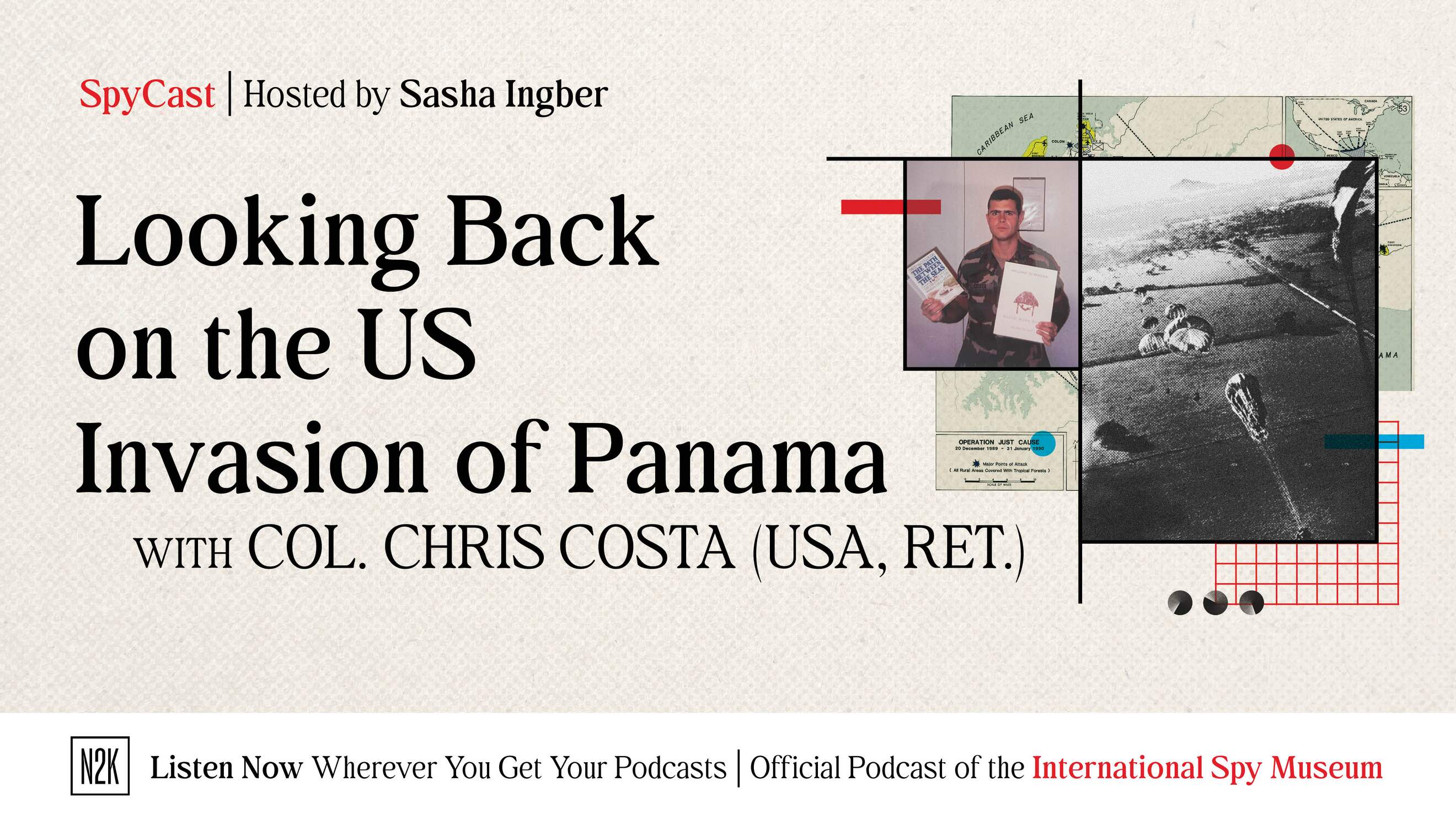
Sasha Ingber: We're also sitting here with this book that you brought. It's on the table here in the studio. Tell us about this book as we continue to talk about the early moments of the invasion kicking off.
Chris Costa: yeah, I'll be super brief about this. It's, uh, it's important to me in, in, in our family lore, the book is The Path Between the Seas. It is a David McCullough book, and it, it is about the creation of the Panama Canal, but soldiers universally are expected to go into combat or go into a combat operation or a dicey situation. You leave a note for your family, you leave some remembrance in the event something bad happens. So that night I had the wherewithal, I was checked literally into a billet. When I recognized that I was going to be a part of the operation at midnight, I went and, uh, purchased very quickly this book, and I went to my billet recognizing that I wouldn't be coming back to my billets anytime soon.
So I had somebody take a picture of me holding the book and the fact that I was in the billets, uh in Panama, and I wrote a note in the book for my family, which I, I, uh, I won't read, but, uh, in the event something happened to me, they would've found a book and, and found a note. I bought that book just so I could leave a little bit of a record.
I had no idea I was gonna be working at a museum and I would be in a position to tell these kinds of stories, but I'm glad I did it. But most importantly, it's something my family has. It's a part of our family history, so to speak.
Sasha Ingber: So you're coming off of this night of bad sleep. Um, hearing mortars, your role is to interrogate people as a counterintelligence officer, but the physical infrastructure of this joint interrogation facility, you told me hasn't even been built yet.
Chris Costa: Yeah. So after the mortar incident at Corozal at 470th headquarters, we tried to lay down for a short. Uh, you know, respite, but no one was gonna sleep. Adrenaline was pumping, so it was time to move out in, in the early hours of, of 20th December, take some back roads in a caravan, some really quick contingency planning.
It was very quick. Down and dirty. We moved to the joint interrogation facility. It had not yet been built likely to preserve operational security. Panamanians are gonna know there's gonna be an invasion if you build prisoners of war cages or interrogation facility. Right. So literally while Panamanian defense forces and intelligence officers were being rolled up by targets across the Isthmus as they were being rolled up and brought to the joint interrogation facility, literally it was being built so we could do counter intelligence screening and questioning.
Sasha Ingber: How were you able to differentiate between a civilian and a military officer who might be a threat?
Chris Costa: Yeah, so I have the distinction and privilege of having been a counterintelligence guy in a combat zone, doing real, no kidding counterintelligence screening. Candidly, as these Panamanians were brought in my job was to essentially very quickly assess who are these individuals? Where were they captured? Do they fit the profile of an intelligence officer? Are they wearing a uniform? Do they look disheveled? Do they look like somebody that's been on the run? Have they had access to uh, Panamanian Defense Force Headquarters.
What kinds of information do they have? Are they cooperative? What is their demeanor? All of these things factored into where do they go at the joint interrogation facility? Do we wanna spend more time debriefing them? Is this a hostile interview? And to be clear, nobody was putting their hands on these individuals.
It was no kidding by the book interrogation and screening. Um, and this played out all night long in the early hours of the invasion on the 20th.
Sasha Ingber: And US forces were grabbing people off of the streets. So they really could be member of the Panamanian Defense Forces, or they could be an innocent person walking down the the street.
Chris Costa: That's right. That's right. Or they could be dignity battalions. So we had to separate the wheat from the chaff, so to speak.
Sasha Ingber: Right. And you had to do it quickly because there were lines of people here, but among the people who were lined up in this crowd, there was a Cuban diplomat.
Chris Costa: As an intelligence officer, I recognized this guy could be, um, a Cuban intelligence officer.I just decided to walk him over to a stump, sat him on the stump and said, don't move, stay here. He pulled out very cool a cigarette, and uh, spent many hours sitting on that stump. I got him some water and some food and went back to my business. I kept an eye on him, but he wasn't going anywhere.
Sasha Ingber: Just sitting on a stump, smoking a cigarette.
Chris Costa: That's right.
Sasha Ingber: So were there aspects of what people told you in these interrogations that ended up proving particularly valuable?
Chris Costa: One. It was corroboration of what I knew was happening on the ground. So I had firsthand accounts and there was a little bit of emotion involved from the individuals I interviewed and interrogated because they were sharing their perspectives and their asides.
By the way, we would've surrendered if you just gave us a chance. We had ample opportunity to lay down your arms, uh, and at the end of the day you were combatant. So. That dynamic played out, and I should note that it wasn't just about understanding the narration of what was playing out, this was about trying to identify are there any sources of information?
Where is Noriega? Where are some of the senior key leaders, where are the intelligence officers? Oh, by the way, are there any intelligence officers sprinkled among these people in the joint interrogation facility? Can you discreetly tell me, is there anybody here you know, works for the Panamanian G2 Intelligence?
These are things that our priority requirements playing out. Where is Noriega right now? Of course, US special operations in the US intelligence community was trying to track Noriega throughout the invasion and prior to the invasion. You always wanna know where your target is.
Sasha Ingber: When we come back, Chris takes us into the comandancia, the headquarters of the Panamanian Defense Forces.
And this is kind of almost sort of surreal and dreamlike that you and one of your intelligence colleagues decided, let's go to the comandancia, the headquarters of the Panamanian Defense Forces. We looked at photographs before we sat down together, so it almost felt like a dream where what you're seeing is so surreal from room to room.
Chris Costa: Yeah. I'll try to give you kind of a, a word picture of what I saw and, and why I ended up at the comandancia. Essentially, I found a lieutenant that was very, very sharp. He spoke fluent Spanish. He was very knowledgeable of what was going on in Panama because he had been engaging with Panamanians for some time.
So we decided the joint interrogation facility had enough help. We'll go find something else that's more critical, uh, a better way to contribute to the fight and then to jump ahead to the comandancia, which conjures up a ghost-like building in a bad part of town. You didn't want to be a Panamanian and go to the comandancia because you might not come out of the comandancia. Like ghoulish stories and, and fear played out in Panama. This was a individual that was vicious. I'm talking about Noriega, and our objective was to do what they call sensitive site exploitation, which meant we had intelligence requirements we had to answer. There were very specific things that we had to look for, I won't get into, at the headquarters. We wanted to find those documents, who we wanted to quickly get them to the right customers, the right consumers in the battle space, because the invasion is still playing out. Now the context is the comandancia got struck multiple times on the evening, uh, in the early mornings of 20th December.
They were hammered and the US military forces had seized the objective at the comandancia. US military forces in that neighborhood were killed. Some were killed by friendly fire, so it was a horrific situation. When we got there, we were now in a somewhat exposed comandanica because the roofsad been burned out.
They had received indirect and direct fire from US military forces. Some of it had caught on fire. At first, we were concerned we were gonna find lots of bodies. We didn't know what we were gonna find. I was armed with not only weapons, but I also had a very large industrial strength flashlight because we knew we were gonna move into a building that had no lighting and had reportedly tunnels and escape rooms. We didn't know exactly what we were gonna encounter because there wasn't the kind of intelligence that I would've liked going into that environment or certainly that in the contingency that I had access to at the time. So we understand it from the outside, the condition of the building and what it's been through in these previous hours.
Sasha Ingber: But when you step inside, what does it smell like? What does it feel like?
Chris Costa: Yeah. Let me give you a flavor for what we found. Adrenaline's pumping. It is surreal. That's a great word that you used because now we are in the heart of the beast. We are at Noriega's dreaded comandancia headquarters on or about the 21st of December.
The sewer system is broken, but there is a pervasive horrendous smell. And it turned out since there was no electricity, this was on the eve virtually of Christmas, all the food that Noriega was gonna get to his cronies and friends and send out care packages to his, you know, malign networks in Panama, his cronies, was rotting. I was armed with small arms and a very large industrial size flashlight. Why? Because there was no electricity and I knew we would be moving through spaces, safe rooms. We didn't know exactly what we were gonna encounter, so we had this horrendous smell. There was no power. Papers were strewn about.
We even found Noriega's uniforms, his desk, his office space.
Sasha Ingber: What is it like to be in Noriega's office?
Chris Costa: So it was surreal. There's no better way to describe. Papers were strewn everywhere. There's Noriega's cowboy hat. There's Noriega's Construction helmet with his name Stenciled on it. Panama Canal Commission.
Manuel Noriega. There's some macabre pictures, some pictures of individuals that were likely interrogated or tortured at the same time. We found, and I'll be polite here, I, we found, uh, the Latin American equivalent of Playboy in Noriega's desk and, and around the desk juxtaposed with a, a Christmas tree that had fallen onto, uh, the side of his desk.
And I wanna make a point. The United States had a pretty good bead on Noriega all the way up to the point of each hour you when the invasion kicked off. So we did not have the kind of technology that we have today. There was no such thing as drones. There was no such thing as National Geospatial Intelligence Agency.
All of these things, um, that we have today. And the fact that it seems like in Venezuela there was excellent human intelligence, very surreal.
Sasha Ingber: And here's another part that's a little bit strange. Noriega is now hiding inside the Vatican's Embassy. There's rumors that he's dressed as a woman to evade detection. I don't know if that's true or not.Tell us about his surrender.
Chris Costa: So I wasn't there during his surrender, but I was there on Christmas Eve day. So I was there when Noriega turned himself into the Papal Nuncio, which is essentially an entity of the Vatican. It has diplomatic protection. So Noriega turned himself in, and famously, once he did that, essentially the United States could begin to consolidate across Panama on their objectives.
And now it was about getting Noriega dislodged from the Vatican, and that was done by diplomacy, but also psychological operations. Like what? Like Van Halen played on famously on huge speakers to cause Noriega to essentially lack sleep. I should say that defense intelligence agency was very much involved in trying to get Noriega out of the Vatican Enclave, the Papal Nuncio. And ultimately, uh, they used one of his mistresses as leverage to try to get her to talk Noriega into coming out. And of course he left in early January and he turned himself in in the DEA slapped handcuffs on him, the Drug Enforcement Administration. And that's when it looked a lot like the Maduro operation, a drug kingpin facing justice in the United States, arrested by DEA.
Sasha Ingber: and he ended up going back to Panama years later, I think in 2011 he was in a wheelchair. He ended up asking his country for forgiveness and died of complications for surgery for, I believe, a tumor. Before the operation there had been skepticism about integration, about the effectiveness of the Unified Commands, joint Chiefs of Staff. Intelligence. What did the operation show?
Chris Costa: Yeah, I think it showed successful integration. Quite candidly, I've heard some general officers recently, pundits talking about Venezuela and making references to Panama.
Of course there were lots of lessons learned. There were huge mistakes made tactically in any conflict, and there were mistakes made. There was friendly fire. So that in itself is horrific in a combat environment, but it happens and you do the lessons learned. Grenada was a mess in terms of joint, interagency coordination.
It was through the operation in Grenada to invade an island where, again, the Cubans were essentially creating a proxy government. That's a whole other story. But the United States in the aftermath of a successful military operation recognized there wasn't joint interoperability. Panama was a success story for individuals talking together.
I'm talking about units coordinating, communicating, contingency planning. One of my friends that was in the seventh Infantry Division in the Atlantic side of Panama, had already deployed prior to the invasion, had conducted multiple rehearsals and planning exercises. So I think it was a great example of evolution.
When you think about military operations. Flash forward in the aftermath of 2001, there was an evolution and the United States is big on learning lessons in combat zones or trying to.
Sasha Ingber: So what were some of the lessons that you learned from Operation Just Cause?
Chris Costa: First of all, during combat operations, there is a tendency to reckless abandon, move toward the objective.
I believe that if I had to do it all over again, I would've slowed down the tempo. I would've had to go to go to hell plan, which essentially means multiple layers of contingencies. I would've made sure everybody was briefed for my specific mission. I would've come armed better armed with what are the, not just the priority intelligence requirements, but what are the other intelligence requirements?
So I would've done more preparation even before executing the tactical operations that I was executing. Also, safety. You never throw safety out the window. We were moving like Mad Max from from 470th headquarters to one location going from the joint interrogation facility back to the headquarters and then to the comandancia itself.
We were moving far too fast. We weren't secure in the vehicle. So slow down the tempo. Think through the problem in safety and risk. Factors need a risk assessment analysis needs to be built into combat operations. And we have learned that the United States in spades over the years, but at the time I was young and uh, I was [00:28:30] not as prepared as I should have been for that environment.
In some ways, I had to, you know, react instinctually for that combat experience.
Sasha Ingber: So let's look at the capture of Maduro through this lens. Yeah. There are some similarities, there are some differences. Nobody died seizing Maduro, right? 23 Americans died in Operation Just Cause, right? How do you make sense of it all?
Chris Costa: Sasha, thanks for acknowledging the 23 deaths of service members and three civilians, along with countless, I'm not even sure what the numbers were for Panamanian civilians that were killed, caught in a crossfire. So all of that said there's a great comparison to Maduro in the operation, but there are more differences than there are similarities.
Let's talk about the operation first and foremost. Special operations was used as we've talked about in this program, um, successfully on the ground in Panama, and obviously it was used successfully in Venezuela for the detention, you know, the capture of Maduro, the end state turned out the same DEA handcuffs bringing a narco trafficker, somebody indicted by the United States, both Maduro and Noriega, back to the United States to face justice of a US jury.
That is really important. But the amount of intelligence the United States reportedly had in Venezuela was probably. Better. Also, the human assets that seem to be close to Maduro, were providing real time reporting on his location. Although US military forces were apparently one step behind Noriega and Panama, we didn't have the technology that we have today.
We had no drones. Also, cyber weapons that may have interfered with electricity and. Uh, communications and other deception triggered by cyber. No such thing in 1989, and we know that that was also used as those aircraft were coming into Venezuela, flying a hundred feet above the water.
Sasha Ingber: What lessons do you think were taken from the invasion of Panama into the invasion in Venezuela to grab Maduro that night?
Chris Costa: Look, I think the lessons Sasha are still playing out if they're gonna continue to be assessed. We don't know where this is going, but one of the key lessons is the United States. If you want to grab somebody, then you do it with a force that can go in get 'em, take 'em out. Venezuela is not a country building program right now. The day after didn't turn into what happened in 2003, Iraq, which is also being thrown out a lot as a comparison. So the idea, the salient lesson, is you want to get that dictator out. The precedent was set with Noriega, which is an important comparison, but you get them out of the target area and bring 'em out of the environment. One of the key and salient lessons was you don't need an occupation force to roll up an individual. You bring a force in of special operations. You grab the individual, you get 'em off the objective, so you do not need to execute an entire invasion, but this is where there's differences.
The United States already had military forces on the ground. There were already still US citizens on the ground in Panama. The United States wanted to restore order, get the Panama Canal functioning again, because it was a vital national interest. So that's where it's very different Panama in comparison to Venezuela.
One point of comparison is absolutely critical, and that is special operations components. Air, land and Sea did an incredible job by all accounts, both in Panama and on the ground in Venezuela, so I couldn't be more proud of special operations components in both scenarios.
Sasha Ingber: As a last question, how did the people of Panama feel about this operation? There was worldwide condemnation and then do you think that what happened in Venezuela will ultimately follow a similar route where the people of Venezuela may feel differently than how it got seen by the world?
Chris Costa: Yeah. It is really difficult for me to forecast what's gonna happen in the future. There are analysts that are way better prepared than I am, but I would just offer this throughout United States operations in Latin America, everything from covert action by the CIA that famously played out everywhere from Chile to Guatemala. There is always a Yankees go home sentiment that plays out in the population. In many cases, it's stoked by strong men leaders that work against US interests.
So I truly believe that the population is in favor of normalcy. They certainly were in Panama. You must remember that on Christmas Eve, on December 24th, 1989, I got in a plane. Noriega was captured. My work was essentially done when it was time for me to go back to Panama. When I did go there, I felt like it was getting back to order.
I could see the objectives, the burnt out buildings where the United States struck them as targets, and it was normal again. Panamanians wanted to get back to their life. The Panama Canal Commission wanted to start running the Panama Canal again. So in most cases, a lot of that anti-American sentiment that I saw in Central America was stoked in many cases by the strong men government, but we do have a checkered history in the region in terms of covert action going back decades. But this invasion, Venezuela could have continued as a covert action as alluded to by President Trump. Instead, it turned into the operation that we saw played out. Panama didn't have to be an invasion, but there was a red line and HW Bush had a decision point and his decision was to execute Operation Just Cause to secure a vital US national interest, and that was the flow of commerce through Panama and to protect Americans and Panamanians from a corrupt Panamanian defense force.
Sasha Ingber: And now it's a place that a lot of Americans go today on vacation. They live there. So measurements of success in that.
Chris Costa: That's right. I mean, I've been there as a tourist in the last few years. We keep using the word surreal. That was surreal.
Sasha Ingber: Now I just wonder what happened to Noriega's cowboy hat.
Chris Costa: I left it there.
Sasha Ingber: Noted. And on that note, Chris, thank you for taking the time to really bring us into this operation from the standpoint of an Intel officer.
Chris Costa: Well, it is a privilege as always for me to be able to help illuminate something that happened in history from an intelligence officer's perspective. So I love what you do, Sasha. I love our programs here at the International Spy Museum, but I thought the timing was really important to tell part of my story that was never told, or the American story, the American GI story of Operation Just Cause.
Sasha Ingber: Thanks for listening to this episode of spycast. If you like the episode, give us a follow on Apple, Spotify, or wherever you get your podcasts, and leave us a rating or review. It really helps. If you have any feedback or you wanna hear about a particular topic, you can reach us by email at spycast@spymuseum.org. I'm your host, Sasha Ingber, and the show is brought to you by N2K Networks, Goat Rodeo, and the International Spy Museum in Washington, DC.